Nobody performs
No one is sent to the front of the room to be funny while everyone watches. Exercises are done together, usually in pairs or small groups, often with the whole room going at once.
Home/Approach
Sessions are built on the Process of Development, a model for moving people out of what they already know and into the range where they are able to learn something.
Let’s Talk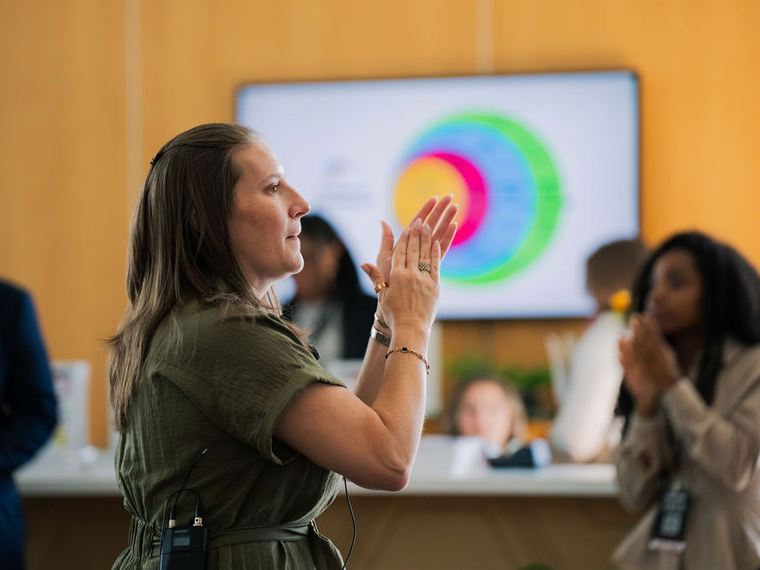
In their words
Their workshops allow athletes to safely come out of their comfort zones and experience themselves, and each other, in a different way. They create an environment that allows players to make discoveries about themselves and life.
The Process of Development
They also shut down if you push them straight to the edge. The useful ground is the band in between, and the whole job of a session is to get a group into it and keep them there.
Where the model comes from
The zones are a working version of Lev Vygotsky’s zone of proximal development, the idea that people learn most in the space just past what they can manage on their own, with help.
Lainie studied that tradition at the East Side Institute in New York, whose work centers on play and performance as engines of human development, and first put it into practice at the All Stars Project.
Vygotsky was writing about children learning to think, but this theory and methodology applies to humans of all ages. We always possess the ability to learn, grow, and develop throughout our lifetimes. Our work walks you through that process.
Why improv
An improv game makes the room adapt while it is happening. Three properties make it useful for this work.
That combination moves a group into the learning zone quickly, and it does it without anyone being asked to talk about their feelings first.
A session
Sixty minutes with a rookie class or a half day with a front office, the arc is the same one.
Participants engage with each other through games that are simple and accessible, which gets the first laugh out of the way early and takes the temperature down.
Exercises build toward ones that require real listening, collaboration, communication, and trust. This is the point where the group notices that the person who is best at their job is not automatically best at this, which is usually the most useful thing that happens all day.
Exercises are designed to work with breakdowns, so the group practices recovering together with low stakes. We build the neural pathways that make us adaptable, flexible, and creative in real time.
The last stretch connects the exercises to real-world application and to how the work shows up in daily life. Without it, a session is a fun afternoon. With it, people leave with language for something they now have direct experience of.
Before you book
Every group arrives with at least one person who may be hesitant to be there. That is expected, and it is planned for.
No one is sent to the front of the room to be funny while everyone watches. Exercises are done together, usually in pairs or small groups, often with the whole room going at once.
The games are built so that everyone fumbles early and often. A room where everyone can safely fail, learn, and recover is a space where people discover just how much they are capable of.
Nobody leaves with a tight five. Improv is a method for practicing attention and adaptability under mild pressure, and it happens to be funny while it works.
The person at the back with their arms crossed is not a problem to be solved. Sessions are paced in a way that even the skeptics quickly see they are better improvisers than they thought, and they willingly go where the group supports them to go.
The games and exercises safely took me out of my comfort zone, and I was pleasantly surprised by how quickly they brought down the walls, allowing us to speak frankly and honestly about our work.
Knowing whether it landed
Applied improv is hard to reduce to a number. Here is what is actually observable.
A brief phone call is usually enough to work out whether this fits your group and your calendar. If someone referred you, please mention who.
Let’s Talk